Archive for category high-tech

How to install Ubuntu on Chomebook (CR-48) and put parental control

I have had a couple of first-generation Chromebook (CR-48) for a while. I thought these would be pretty good portable computing devices to give to my kids. However, I wasn’t ready to do so unless there was some sort of parental control. As someone who spends a lot of time online, it’s too rough place for kids to roam around. I have known about their support for dev mode, and I decided to figure out which linux flavor would support CR-48.

First search attempt turned out Ubuntu, and since Ubuntu is known for better UI, I decided to give it a try. I also found out there is an excellent parental control guide on Ubuntu as well.

Install Ubuntu on Chromebook (CR-48)

There is no need to re-invent the wheel. Follow instruction here to put Ubuntu 11.04 on Chromebook (CR-48). It worked out like a charm.

Parental Control on Ubuntu

There is a great guide here, and I couldn’t get the Web Content Control to work. However, timekpr is pretty good. You should at least install that.

For filtering content, ProCon Latte Content Filter Firefox Add-on has been working pretty well.

So far, I have been happy with Ubuntu on CR-48. It’s slow and keypad doesn’t work too well, but I think kids are just happy to have their own laptops. :)

Post to Twitter

Tags: , , ,

How to install KidsRuby on Mac OS X and Ubuntu

I have two kids, and I have been wanting to find ways to introduce my kids to programming. Especially for my son, who has asperger syndrome. I thought programming would be a good way to use his interests in logic and mathematics to good use.

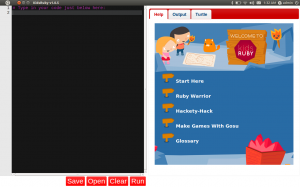
I was so much in joy when I found KidsRuby. It’s an awesome project. I think Ruby is a great first language because of its elegance and object-oriented nature to the core.

Previously I had a hard time installing KidsRuby my Mac OS X, due to qt installation error. I was able to at least get it going by cloning their git repository. I had filed a bug for the qt installation error, and the author responded some time ago, but I hadn’t had time to verify it.

I finally had time to verify it, and it worked like a charm.

I also had converted two first-generation Google Chromebooks to use Ubuntu to give to my kids. And while I was familiar with Fedora, this was my first time using Ubuntu, and as new user, I had to search around the net to install Ruby and to install KidsRuby. I am close to finishing it, and I will describe it here.

Mac OS X

This one is pretty easy. Just download the installer dmg file from here, and follow the instruction. It will take a while, but it would be well worth it. You can find the KidsRuby folder in Application folder.

Ubuntu

Now, this one took a while. If you have Ruby installed already, you are good to go. If not, follow the direction below.

If Ruby isn’t installed

You can simply follow the direction from Ryan Bigg to install Ruby 1.9.3.

If Ruby is already installed

I am not sure which version of Ruby is supported, but this applies to Ruby 1.9.3.

The biggest problem I faced was the problem with ffi gem. I kept getting the following error.

Installing ffi (1.0.10) with native extensions
Gem::Installer::ExtensionBuildError: ERROR: Failed to build gem native extension.
 
        /usr/bin/ruby1.9.1 extconf.rb
:29:in `require': no such file to load -- mkmf (LoadError)
	from :29:in `require'
	from extconf.rb:4:in `'
 
Gem files will remain installed in /usr/share/kidsruby/ffi/ruby/1.9.1/gems/ffi-1.0.10 for inspection.
Results logged to /usr/share/kidsruby/ffi/ruby/1.9.1/gems/ffi-1.0.10/ext/ffi_c/gem_make.out
An error occured while installing ffi (1.0.10), and Bundler cannot continue.
Make sure that `gem install ffi -v '1.0.10'` succeeds before bundling.

After searching the net for a while, I realized that I needed to install “-dev” package as well. Since I am using 1.9.3, I had to install ruby1.9.1-dev.

sudo apt-get install ruby1.9.1-dev

After that you can clone the git repository and install necessary packages.

git clone https://github.com/hybridgroup/kidsruby.git
 
cd kidsruby
 
sudo apt-get install libqt4-dev
sudo apt-get install cmake
gem install qtbindings
bundle install

The bundle install part will take a while.

For the lesson part, I had a surprising result – my son totally lost interest very quickly, but my daughter was more into it. :)

KidsRuby on Ubuntu

Post to Twitter

Tags:

Never never give up on your life

When I first read TechCrunch’s article on Diaspora co-founder Ilya Zhitomirskiy’s death, I didn’t think much of it except that it didn’t mention anything about the cause of the death. It usually means only thing, and my suspicion was confirmed by hacker news thread.

http://news.ycombinator.com/item?id=3231531

What I particularly noticed about the thread was discussion of failure and stress of founding a startup and other suicides by very smart folks. It also reminded me of earlier tragic passing of a co-founder of a Y-Combinator-funded company and the article I read on WIRED magazine about two AI scientists committing suicides almost in identical ways.

I would never know why these guys did what they did. But for me, I have one thing that would prevent me from thinking about it. It’s my kids and my family to an extent. It’s a double-edged sword. On one side, it’s the reason for not being able to take huge risk, but on the other side, it’s the reason for my sanity no matter how shitty my life is at any given moment (and my life right now isn’t all that spectacular).

Also, we should also keep things in perspective. In grand scheme of this universe, we are just small part of green/blue spec called Earth. You shouldn’t care about and be afraid of failures/rejections. Who cares? People will forget and move on. I think it’s courageous and commendable to just try. Regardless of outcome, having tried something sets you ahead of many others.

Just remember the following quotes.

“Regret for the things we did can be tempered by time; it is regret for the things we did not do that is inconsolable.”

Also, especially this one.

“It is not the critic who counts; not the man who points out how the strong man stumbles, or where the doer of deeds could have done them better. The credit belongs to the man who is actually in the arena, whose face is marred by dust and sweat and blood; who strives valiantly; who errs, who comes short again and again, because there is no effort without error and shortcoming; but who does actually strive to do the deeds; who knows great enthusiasms, the great devotions; who spends himself in a worthy cause; who at the best knows in the end the triumph of high achievement, and who at the worst, if he fails, at least fails while daring greatly, so that his place shall never be with those cold and timid souls who neither know victory nor defeat.”

Post to Twitter

(org.mongodb.mogod) Exited with exit code: 100

For some reason, I couldn’t run mongo shell and the console was overrun by the same error message like the following.

8/1/11 6:49:15 PM com.apple.launchd[1] (org.mongodb.mongod) Throttling respawn: Will start in 10 seconds
8/1/11 6:49:25 PM com.apple.launchd[1] (org.mongodb.mongod[394]) Exited with exit code: 100
8/1/11 6:49:15 PM com.apple.launchd[1] (org.mongodb.mongod) Throttling respawn: Will start in 10 seconds
8/1/11 6:49:25 PM com.apple.launchd[1] (org.mongodb.mongod[394]) Exited with exit code: 100

And searching on Google didn’t turn up any interesting results.

IT PAYS TO LOOK AT YOUR LOG FILE! Well, this shouldn’t be new, but it somehow skipped my mind until I saw the config file.

In the log file was the following helpful error message.

**************
old lock file: /usr/local/mongodb_data/mongod.lock.  probably means unclean shutdown
recommend removing file and running --repair
see: http://dochub.mongodb.org/core/repair for more information
*************

Mon Aug  1 18:49:35 [initandlisten] exception in initAndListen std::exception: old lock file, terminatingMon Aug  1 18:49:35 dbexit:
Mon Aug  1 18:49:35 [initandlisten] shutdown: going to close listening sockets...
Mon Aug  1 18:49:35 [initandlisten] shutdown: going to flush diaglog...
Mon Aug  1 18:49:35 [initandlisten] shutdown: going to close sockets...
Mon Aug  1 18:49:35 [initandlisten] shutdown: waiting for fs preallocator...
Mon Aug  1 18:49:35 [initandlisten] shutdown: closing all files...
Mon Aug  1 18:49:35 closeAllFiles() finished
Mon Aug  1 18:49:35 dbexit: really exiting now
Well, after deleting the lock file, everything was back to normal.

When in doubt, always look in your log file!

Post to Twitter

Tags:

Relevance in current Internet

I just finished reading TechCrunch article, How Facebook Can Put Google Out of Business. This also reminded me of Paul Adam’s articles, The Real Life Social Network and How Your Customers’ Social Circles Influence What They Buy, What They Do and Where They Go. And also this good analogy of Facebook, Google and other hot startups.

I was also asked a lot of questions about problem of current social media and how I could make it better as part of interview questions. One common answer I provide is the relevance. How important are these news, status updates, tweets, etc. to me? I agree that the biggest difference between Facebook and Google is the core of each company – people (social) or links (web pages).

Many companies are trying to figure out who you are as a person. For example, another favorite startup of mine, Hunch, is trying to figure out who you are and what you would like based on what you already like. Netflix tries to figure out what movies you might like based on your ratings of movies. Amazon has been doing it for a while with features like “you might also like…” Facebook is obviously in good position because of the social interaction data they have – what you shared, who you have interacted with, what you liked, etc. in addition to social graph. Twitter can also certainly figure out by analyzing followers, tweets and especially retweets, but right now I feel that noise-to-signal ratio on Twitter is too high. You control tweet relevance by carefully choosing who you follow.

We are bound to create more data. The amount of data we generate will never decrease. In the sea of data, it would be harder and harder to find information that is relevant to you, but to others. In this sense, Facebook is definitely sitting on a gold mine. It’s kind of creepy, but the more interactions you have on Facebook, the more Facebook knows you, and it provides good targeting data to advertisers. Can Google build significant social product? Nothing is impossible, but I think it would be very hard. Facebook is just too big, and I just don’t see why I would use similar feature on another platform. Once you have your social network established on one platform, it is extremely hard to create the similar network on a different platform. In social network, the winner takes all, unless the winner screws up big time. It could happen (as has happened a couple of times already with Friendster and MySpace).

We are living in an interesting time, indeed.

Post to Twitter

Silicon Valley Bubble

I went back home to the East Coast, Washington DC suburb, this past holiday season. I also went up to see my friends and cousins in NJ and NY. Having the first meaningful conversation with my friends and relatives in about two years made me realize one thing about Silicon Valley.

We (those of us living in the SF Bay Area) are living in a bubble. I am not talking about startup/options/hype kind of bubble, but a tech bubble. I was the one most knowledgeable about up-to-date information of facebook and its eco-system with apps and social games, twitter, google, etc. None of my friends and relatives seem to know nor even care about such information.

It’s just amazing and unbelievable when you think about such high concentration of technical knowledge, talent and money in one geographical area.

Post to Twitter

Korea will be left behind

It’s okay to be patriotic. You should love your country, but it should not keep you from being objective.

In one way, Koreans are kind of Xenophobic. It’s not exactly it because they don’t hate foreigners, but because they think they are better than others. It was very clear when I lived in Korea for two years. It’s media’s fault, which is pretty much propaganda machine for everything to do with Korea. Come to think of it, this kind of blind loyalty is rampant in Korea.

When you are in the middle of it, it’s really hard to tell others about different things. But it becomes crystal clear when you are outside Korea. Whatever Koreans think they are best at, people in other parts of world simply don’t care.

Now, you may ask, “why do you care?” I shouldn’t. What Korea does or doesn’t do doesn’t affect me. So, why? I used to ask that myself, and I found an answer. Because I am a Korean, too (well, 1/2 of me is. Not that I am mixed, but I just happened to live 1/2 of my life in the US). I didn’t want to care, but I can’t help it.

Anyhow, I think Korea is in big trouble. They will be completely left behind in 10 years or so. Because they don’t invest in important technologies. But, you might say, “C’mon. Korea has the highest rate of Broadband penetration! Their mobile technology is way ahead of the Read the rest of this entry »

Post to Twitter

Tags: , ,

Bloglation – Translate, Save, and Share!

Last Thursday, I released private alpha version of Bloglation, which lets a user translate any web page, save and share. It’s supposed to be private, but I need to get some good feedback from real users. If you are bi-lingual (or not) and interested in translating cool ideas, concepts and/or knowledge, please go ahead. And don’t forget to send me any comments/feedback you have.

I also wanted to maintain a separate blog just for bloglation. You can find it here.

Post to Twitter

Tags: , , ,

Infinite possibilities and power of parents

Paul Graham, a successful serial entrepreneur and my biggest idol, just published another thought-provoking essay – After Credentials.

Interestingly, he was referring to a New York Times article on Korean education system. Having grown up in Korea till 16, I had experienced it myself and am in complete agreement with him. I was an odd kid in Korea. I didn’t like following those customary rules just because they had been practiced for many hundreds of years. I hated cramming and being judged by test scores. And it’s so true that a college degree plays a large role in one’s career and life in Korea. Since graduating from college is pretty much guaranteed, once you get in, you are set. Therefore, there is a lot of emphasis in GETTING in to a college, no matter what you major in. So, it’s safe to say that most kids do not major in what they wanted.
Korea is a country RULED by large companies: Samsung, Hyundai, etc. They employ 100’s of thousands of people and venture into all kinds of business, from cars to hospital, theme park, and consumer electronics. Working there means job security, so many college graduates want to work there. Thus, just like what Paul said, credential and pedigree matter A LOT. Also personal connections. It’s sickening. 
It’s one of the reasons why I like the US and the Silicon Valley. Like I mentioned about Obama, it’s the land of infinite possibilities. I’ve worked at many start-ups, and I know that all of them were filled with people from all different backgrounds, and that included educational background. Once you leave your first job, you are judged on your skills, not where you went to school. It’s so true for engineers and also sales folks. Even in the Silicon Valley, the larger a company is – like Intel and Cisco – the more your credential and pedigree matter. 
Raising two kids, I think about what values I bestow upon them. As an Asian, and perhaps the way I was raised, I highly value education and have been sending them to a private school. But as I also grow older, I wonder if it’s so necessary. Of course education is important, but I am not sure if sending them to a private school is necessary. Because, there is so much more important than just learning – creativity, positive attitude, ingenuity, etc. I really want my kids to understand that there are a lot more things valuable than good grades. I want to encourage my kids to be entrepreneurial, try new things, and not be afraid of failures. Do your best and don’t worry. I hope my parents could have taught me something different. I don’t blame my parents at all, but I can’t help but to imagine how things would have been different if I were taught different values. 

Post to Twitter

Mobile Security

From business to everyday users

In US, BlackBerry is often referred as CrackBerry, because of its addictive nature. The best way to gauge its popularity is by witnessing most business users checking their emails or sending messages on BlackBerry phones in airports or even in business meetings. Smartphone has been the weapon of choice for business users, who use it everyday including weekends to find contact information, check schedule, and read and send emails. Those functions were essential to conduct business on-the-go and enough to pay premium for the phone and the service. In addition, since most businesses use Microsoft Exchange for contact management, calendar and email, most smartphone vendors support integration with Microsoft Exchange. While Nokia has the highest market share (~39%) in worldwide smartphone market, US market is dominated by RIM (Research-In-Motion, manufacturer of BlackBerry phones) with about 40% market share followed by not so surprisingly Apple with about 30% market share. Market shares of Microsoft and Palm smartphones have been falling since early 2006, and the same trend continues.

Thanks to Apple’s iPhone, now the flood gate has opened. Prior to iPhone, a slick, trendy version of BlackBerry called Pearl and low-price PDA-type phones called Palm Centro had gained some popularity among non-business users. Introduction of slew of Google mobile applications – Gmail, Google Maps, Calendar, Google Search, and YouTube to name a few – also helped more and more everyday users to appreciate smartphones. Another catalyst was carrier’s introduction of unlimited data plan. But the real tsunami began with Apple iPhone. According to comScore’s report in October 2008, adoption of iPhone by low-income demographics increased 48% from June to August 2008. Interestingly enough, iPhone was a smartphone targeted for consumers, but with Microsoft Exchange integration support, more and more business users are adopting iPhone as welll. The following numbers regarding iPhone are quite staggering, considering that iPhone was introduced to the market only about one year ago.

  • Best selling phone (6.89 million phones) in the US during Q3 2008 – not just in smartphone category. (Source: The NPD Group)
  • Ranked number two in worldwide smartphone market with 17.3% market share and 523% Year-over-Year growth according to a report by Canalys.
  • 300 million apps downloaded through App Store. (Source: Apple)
  • Average of 2.2 million apps downloaded per day. (Source: Apple)
  • More than 10,000 apps have been uploaded to App Store. (Source: Apple)

Table 1 – Worldwide smartphone market share

Another new entrant to the smartphone market with much anticipation was Google’s Android-based G1 smartphone. These two phones, iPhones and Android-based phones will be the center of smartphone revolution now and in the near future.

Openness wins, again

The major reason for explosive growth of iPhone could be attributed to the App Store. Yes, it looks good and multi-touch screen is revolutionizing the whole intuitive user interface movement, but the real drive is its openness. Before iPhone, most phones manufacturers guarded their phones like a walled garden. It has happened over and over before, where too many restrictions hindered true innovations. Users received whatever phone manufacturers or carriers decided to allow. But, iPhone provided a platform for developers to offer their software – for a profit if they wish – and more importantly gave users choices. Users decide what they want to download and/or buy. Developers have motivation to write good programs, better than other developer, so that their software could be purchased more and thus make more money. It’s truly a beautiful system and ingenious business model. The numbers I described above are clear evidence. If the rumor that Apple may introduce $99 version of iPhones before Christmas is true, it would be truly game-changing plan.

The whole premise behind Google’s Android-base G1 phone was also the openness. It’s even more open than iPhone since its operating system (Android) is open source and it does not have as stringent software review process as Apple. Starting December 5, Google is offering a development version of the G1 phone that is both SIM and hardware unlocked. It only costs $25 registration fee to register as a developer on Android Market, and pay $399 for the hardware. Google also plans to expand the territories that it’s available in, but initially it can be purchased in the US, UK, Germany, Japan, India, Canada, France, Taiwan, Spain, Australia, Singapore, Switzerland, Netherlands, Austria, Sweden, Finland, Poland, and Hungary. It’s a shame that most mobile-phone advanced country like Korea is not on the list. Korean mobile phone manufacturer had better wake up to the new mobile world, otherwise they may end up losing a lot of their market shares.

These two phones are shifting entire paradigm in not just smartphone market, but overall mobile phone market. As “Internet” generation grows up and adopt mobile behavior similar to that of desktop and Internet, demand for “open” mobile phones will grow stronger and stronger. It would not be too surprising that most of mobile phones in the future will follow Apple and Google’s model.

Open with care

Today’s smartphones do not deserve to be called phones. They are small computers and mobile phone capability. iPhone’s specification is better than even Playstation Portable (PSP).

Table 2 – Specifications of iPhone and PSP

And this is only the beginning. Be it mobile WiMAX or LTE, carriers will keep upgrading their networks to meet the demand and support faster bandwidth. Apple, other manufacturers of Android-based phone and incumbents will continue to push the envelope, developing better, faster, lighter and more powerful mobile devices. Does this sound familiar? Continuous improvement is no stranger to high tech world, but specifically it parallels laptops. When laptops first came out, they were much inferior to the desktops, as desktop PCs were to mini-computers much earlier. Nowadays, most laptops have become as powerful as desktops. And the day smartphones will be as powerful as laptops is just around the corner. They are not going to replace them, as we still have mainframes, mini-computers, desktops and laptops. They will all co-exist and serve specific roles.

The Internet opened the door to the world, where one can reach anywhere for instant access to any information he or she desires. Also, we have seen some who try to take advantage of the openness. In the dawn of desktops, malware then was limited to virus, and it had very limited way to distribute itself. With open network, where you can reach anyone, anyone can reach back to you. It doesn’t help to have vulnerable operating system and communication tools in the most desktops. Also, as opposed to hobby-like nature of virus writing in the beginning, financial gain is the main purpose of today’s perpetrators, and motivation to write good (?) and tenacious malware is much higher. Open network/system and free market are encouraging creative innovations not only in productivity but also in cybercrimes.

Mobile world is the next frontier (for cybercriminals)

There is a new report just published by Information Security Center of Georgia Tech, which predicts that mobile phones will be next target for botnets. It’s inevitable, as mobile phones are getting more powerful, faster Internet connection is possible and thus user behavior on mobile phone is shifting from voice communications to online communications. Previously, carriers charged users by number of SMS messages or amount of data used, but nowadays most carriers offer unlimited SMS and data plan at very attractive pricing points. The new rate plan in addition to the fact that mobile phones tend to be always on and often security is poor will make them even more attractive target for cybercriminals. The shifting user behavior makes similar “drive-by download” in mobile phones as in desktop possible. Also, another large difference between desktops and mobile phones is the sheer volume. There are estimated to be around three (3) billion mobile phones used worldwide, as opposed to about 800 million desktops. Apple and Google review the uploaded applications before publishing them to the public, but there is no guarantee that they will catch all of the malware.

With relatively low bandwidth, it’s hard to imagine mobile botnets launching massive DDoS (distributed denial of service) attacks. At least not the bandwidth flooding attacks, but logical and protocol attacks are certainly possible since there are so many more mobile phones available than desktops. For example, SYN flooding is quite possible with mobile phones, since it works by sending many requests to a sever and depleting its “half-open” session table, which is able to handle only about 1024 entries. More than DDoS attacks, there is more possibility of fraud and privacy invasion. Malware on the mobile phone can access paid contents and charge to user’s mobile phone account. Since mobile phone stores phone numbers of owner’s contacts, SMS spamming or even personal data leaking is possible. In places like US and others where there is tighter integration between mobile phones and company’s internal resources, the possible damage of data leak is even greater. Also, since user’s location can be pin-pointed using GPS data, a cybercriminal can track certain users for stalking or other criminal purpose. I know certain some companies in Korea already do this, so it shouldn’t be completely inconceivable. There is already an application like FlexiSPY that is used to spy on user activity. After FlexiSPY is installed on a smartphone, it allows you to use the phone to read SMS, e-mail, and call logs from the smart phone from anywhere in the world. The Windows Mobile and Symbian versions even allow you to listen to actual phone calls being made with the smartphone and use the phone as a secret GPS tracker.

There is also no doubt that some cybercriminals will use these powerful smartphones as a tool to a cybercrime.

Seize the opportunity

So far, any serious, widespread malware has been unheard of. It’s because until just about a year ago before iPhone and Google’s Android phones, most phones operated in closed, walled-garden environment. But, as amazing success of iPhone shows, there is huge paradigm shift happening in the mobile phone market right now. I have mentioned several ways cybercriminals can benefit from compromised mobile phones, but if I can think of them, cybercriminals may already have thought of many more creative ways. It’s only a matter of time. There is a great opportunity for a security company to dominate mobile security market. There are already many anti-virus and SMS anti-spam programs are available for all popular mobile operating systems from companies like AirScanner, F-Secure Corp., McAfee Inc., Symantec Corp., SMobile Systems, Trend Micro Inc., and Sophos plc., but none of them is a clear leader yet. Many IT departments in US already have or are in the process of creating mobile security policy. Just as in desktops, they will require installation of security software (anti-virus, firewall, and/or encryption) on smartphnes and can restrict which software can be installed. So far, no major mobile security threats have been widely reported, so they are not on consumers’ radar yet. But, it will just take one outbreak for them to come to the realization. In addition to security software on smartphones, carriers or other 3rd-party vendor could also provide network-based, cloud security services by scanning all mobile data on network level.

For consumers and non-business users, they need to employ the same cautious behavior as in desktop environment. They should always be careful when downloading an application or clicking on a link. Just as in desktop, even with whatever mobile security software they have on the phone, they will not be able to catch everything. They should also create password to access the phones so that their information is relatively safe when stolen. But as in desktop, most users may choose convenience over security, which would be a great tragedy since they may become the source of a large outbreak.

In conclusion, it should come as no surprise that technology advance always comes with double-edged blade. While open smartphones promise another whole new level of productivity gain (or loss to some), they come with a quite strong warning label. But those who seize opportunity will reap great benefits.

Post to Twitter